+44 (0) 1908 200022
 +1 703 574 5313


The UK public sector is constantly changing. In the NHS, the Health Bill1, which is currently going through the House of Lords, would abolish NHS England, moving its functions into the Department of Health and Social Care, with integrated care boards merging at regional level.
In Whitehall, the Department for Science, Innovation and Technology has been merged with the Department for Business and Trade2, just three and a half years after both were created. While ‘digital’ has returned to the Department for Culture, Media and Sport.
In local government, reorganisation is in flux. Surrey’s two new unitary councils are on track to go live on 1 April 2027. And on 29 October 2026, the government confirmed reorganisation will go ahead in five more areas3, while decisions for nine others were withdrawn to be reconsidered. But whatever the final map looks like, the direction is clear: councils will keep merging services, sharing back offices, and rebranding to make budgets stretch further.
Organisational change usually means new brand names, new web domains, and new email addresses, which poses significant risk to the online estate if old ones are left behind. For example:
- Following a trust merger, an NHS stroke recovery website, My Therapy4, was forgotten. Years later, it was found to be promoting casino sites.
- Passengers logging on to the free Wi-Fi at 19 of Britain’s busiest railway stations5 were met with offensive messages instead of a login page.
- The Department for Education confirmed a breach6 by ExfilSquad, who later went on to attack the Police National Legal Database.
- Isle of Wight Council7 fell victim to a phishing email from a trusted supplier, which potentially exposed families’ data.
Four sectors. Four very different attacks. But with one thing in common: threat actors that had simply taken advantage of what was left behind.
What can you do to ensure your online estate moves with you?
Too often, the people in the know are the ones moving on. To make matters worse, the incoming teams may already be stretched, with limited capacity to take on any legacy issues. According to the National Audit Office (NAO)8, one in three cybersecurity roles in government in 2023-24 were vacant or filled by temporary staff, and 70% of specialist security architects in post were temporary.
However, this doesn’t mean you’re destined for disaster. The following are five practical steps you can take to make sure your online estate doesn’t get left behind.
1. Domains: set the forwarding address
Domains are the quiet force behind every public service online. Every web address, email address, and login depends on one, which is exactly why they need to move with the new organisation and not be left behind with the old one.
GOV.UK’s guidance9 is clear: check your domains at least every six months and, if your organisation “changes name, ceases to exist or no longer needs the domain”, secure it properly, because “unused domains are vulnerable to hijack”. The .gov.uk and nhs.uk names are protected by controlled namespaces. But campaign sites, apps, partnerships and old brands often sit on .org.uk, .co.uk or .com domains, where expired names can eventually become available for anyone to register.
What good looks like
- Take an inventory of every domain involved in the change, before anything moves.
- Decide whether to keep, redirect or retire each one.
- Keep renewals running quietly in the background so nothing lapses by accident.
2. Security and performance: hand over the keys properly
The public expects official websites to be safe, fast and available, whatever is happening behind the scenes. During a change, that assurance comes down to one question: who holds the keys?
Registrar accounts, admin logins, DNS control, and certificates often stay exactly where they were, long after the people who set them up have moved on. Network Rail’s Wi-Fi incident shows how much a single login can access.
The busiest weeks of a change are when attackers like to strike. In January 2026, the National Cyber Security Centre (NCSC)10 urged organisations, “particularly local government authorities”, to strengthen their defences against denial-of-service attacks, which “can prevent people from accessing the essential services they depend on every day”.
What good looks like
- Move every credential, DNS record and certificate to a named owner in the new organisation.
- Close down old supplier access.
- Automate certificate renewals before the move.
3. Hosting: plan for the worst-case scenario
Hosting is the heartbeat of every online service. When two organisations become one, two sets of hosting – including contracts, data centres, cloud tenancies, and legacy systems – need to be brought together under one clear plan. Done well, it’s a chance to modernise, not just to merge.
And there’s plenty to bring up to date. The NAO found8 at least 228 legacy IT systems in use across government, and 58 critical systems assessed in 2024 had significant gaps in cyber resilience. When those systems fail, the public feels it: a cyber-attack on a pathology supplier in South-East London led two NHS foundation trusts to postpone 10,152 outpatient appointments and 1,710 elective procedures.
What good looks like
- Decide what survives on its merits rather than by default.
- Know exactly where your infrastructure and data live.
- Test backup and disaster recovery before the cutover.
- Plan for your worst day – peak demand, an attack, and a supplier failure in the same week.
4. Brand protection: watch both names
People are more likely to trust anything that looks official, and fraudsters know it. Concerned customers reported more than 170,000 scams to HMRC11 in the 12 months to July 2025, and in a single year, HMRC reported 26,443 malicious web pages12 for takedown.
Change opens new gaps. A new organisation name, a rebrand, or a new digital service is an invitation to register a convincing lookalike. And the social media account of an organisation that no longer exists is a ready-made, already-trusted voice for anyone who gets hold of it.
When the UK’s Electronic Travel Authorisation went live for European visitors in April 2025, VisitBritain was already warning13 that travellers were “inadvertently clicking onto incorrect visa links”. One traveller paid the £10 fee on a legitimate-looking site topping her search results, then found an extra £79.50 “processing fee” on top.
What good looks like
- From the day a change is announced, keep watch over the old name and the new one across domains, social media, and app stores.
- Spot lookalikes early, investigate them and get them taken down fast.
5. Strategic oversight: maintain oversight of the whole move
In most organisations going through change, responsibility is neatly divided. The outgoing web team owns the old site. The incoming IT team owns the new estate. Comms owns the social accounts. Procurement owns the supplier contracts. But nobody owns the gaps in between.
Outsourcing doesn’t close those gaps either. GOV.UK guidance14 says that even when a supplier manages a domain, the organisation “still hold[s] ultimate accountability” for it. Regulation is moving the same way: the Cyber Security and Resilience Bill15, which is now in its final stages in Parliament, brings medium and large managed service providers and data centres into scope.
What good looks like
- One view across the whole estate.
- One owner for the move.
- Experts who work alongside your own teams in IT, digital, comms, legal and procurement.
- Clear reporting to show the board, an auditor or a regulator that nothing has been left behind.
One online estate. Whatever shape you take.
For the people steering public-sector organisations through mergers, restructures, and new names, the important question isn’t “Who owns the website?”, it’s “Who is looking at all of it together?” Domains, security and performance, hosting, and brand protection, viewed as one online estate, so gaps can’t open.
This is precisely how Safenames works. Not another supplier to manage, but an extension of the teams already in the room. Helping them see the whole picture, rather than just their own corner of it. And carrying every part of the estate through the change, rather than tidying up afterwards.
It’s the same approach that has seen organisations, such as the NHS, the Foreign, Commonwealth and Development Office, the Cabinet Office, the Medicines and Healthcare products Regulatory Agency and Ofsted trust us with managing and protecting their online estates, from our UK base and through the G-Cloud framework.
Because when your organisation changes shape, the address still needs to lead somewhere safe.
Ready to strengthen your organisation’s cyber resilience?
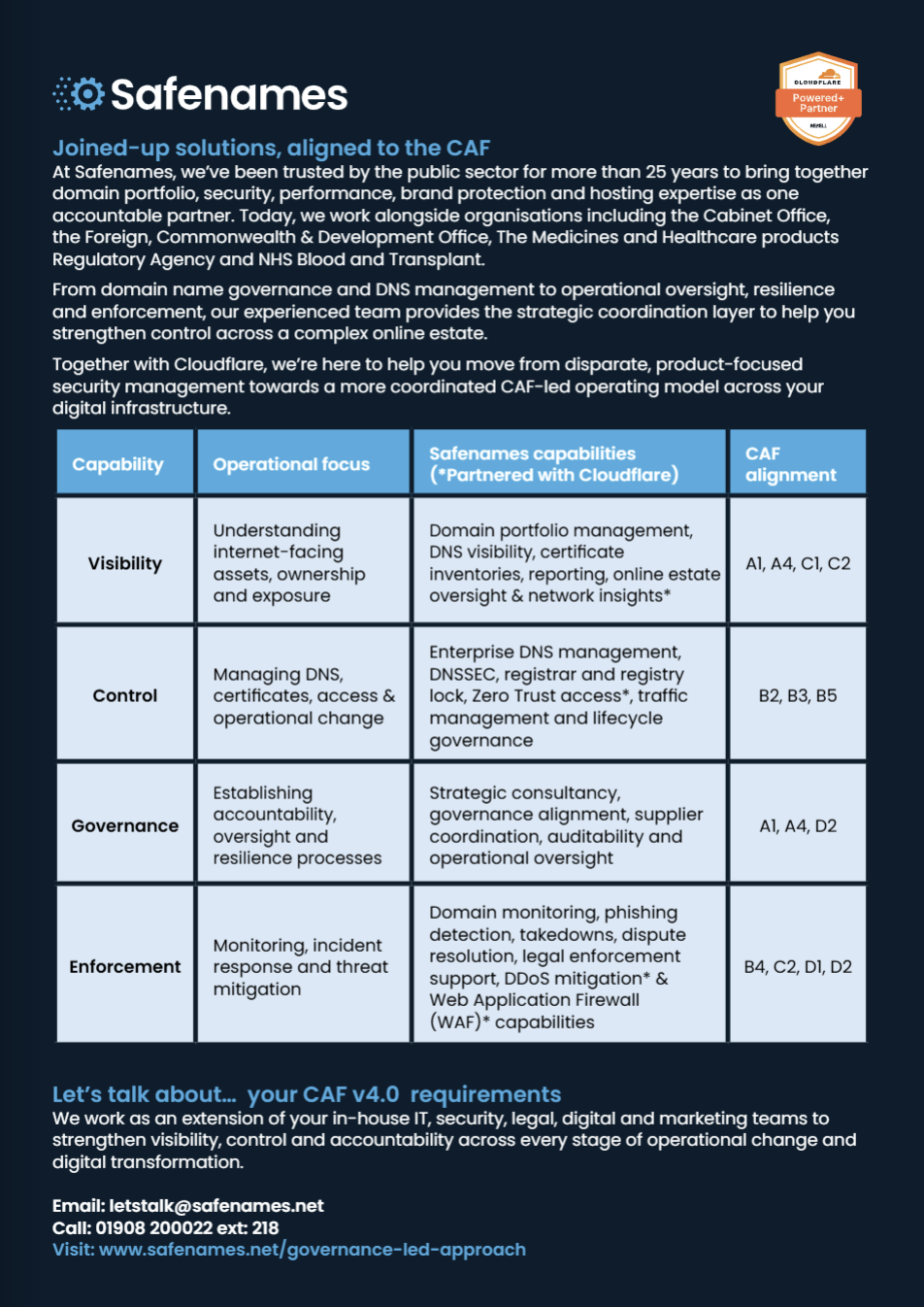
Whatever shape your organisation takes, the NCSC’s Cyber Assessment Framework (CAF) is increasingly how its resilience is measured. Our white paper, ‘How to strengthen public sector cyber resilience’, sets out a CAF-aligned approach to domain name security, DNS and digital infrastructure, with practical questions to ask your own teams and suppliers at every stage.
Download the white paper →