 +44 (0) 1908 200022
 +1 703 574 5313
Do you need to switch off your .com if you own .yourBrand (your dotBrand)?
Mar 4, 2026, 14:42 pm
If you’re considering whether owning .yourBrand is a good move for your organisation, it may help to know there’s no need to retire your .com, your country sites or anything else you’ve already built online if you decide to go ahead.
Having .yourBrand simply means you’ll own your exclusive corner of the internet – and have complete control over it – to exist alongside the websites you already rely on.
Most of the brands that took up .theirBrand in the 2012 application window are successfully using this model. For example:
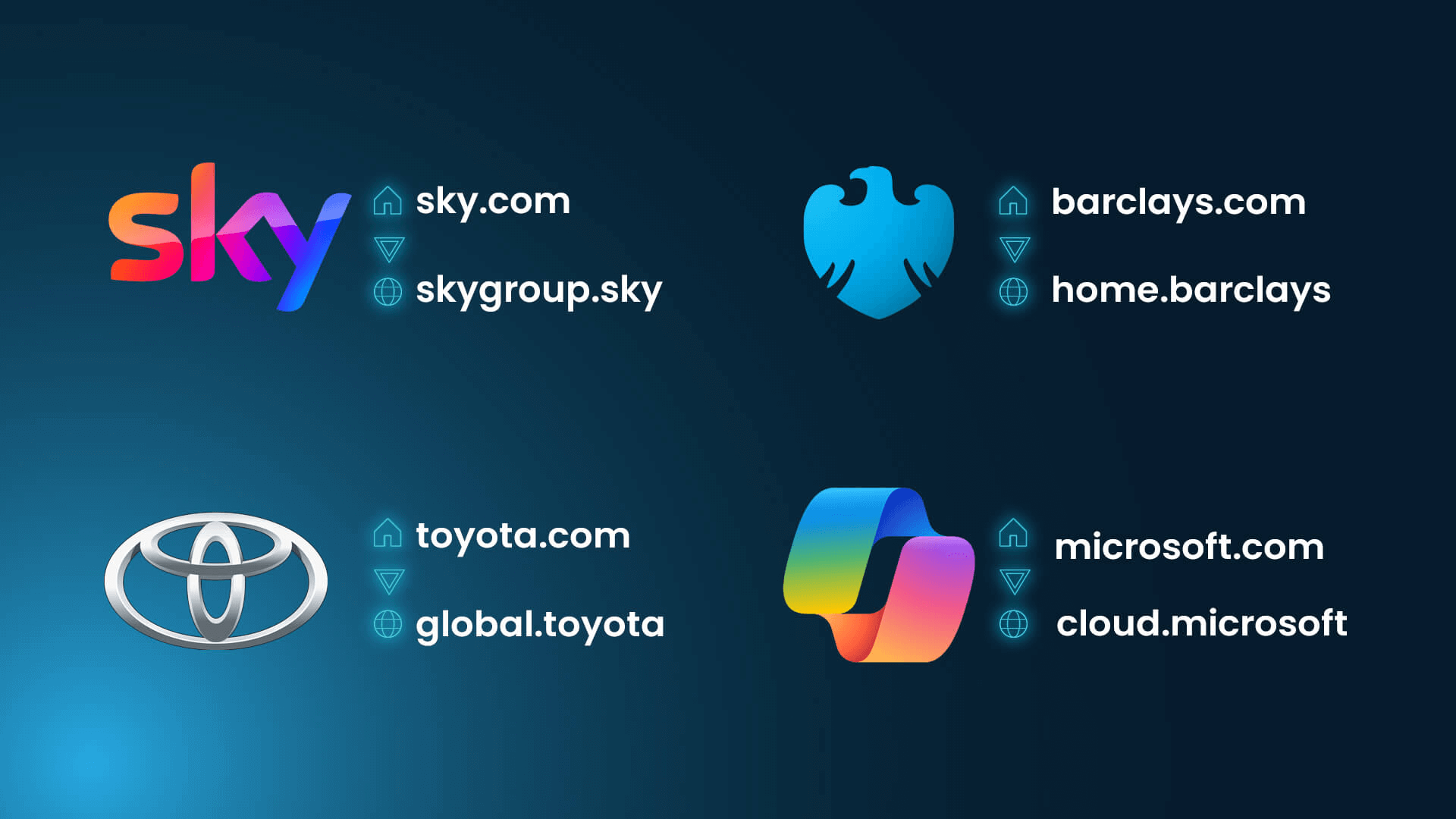
The above logos and domain examples are shown for illustrative purposes only. These brands are not clients of Safenames.
How your .com and .yourBrand can live side by side
It’s natural for your early internal discussions to centre around whether running .yourBrand next to your .com and other top-level domains will actually work for your organisation in real-world terms.
Picturing .yourBrand coexisting with your .com as places rather than domains may help, especially as most organisations operate two kinds of physical spaces.
There are the public-facing places anyone can access – shop windows, front doors and reception areas. And then behind that frontage, you may have secure gates, buildings, controlled access points or staff-only environments where responsibility and accountability live.
In online terms, that means:

Your .com becomes your public frontage
Your .com and other public domains are designed to be open. They’re visible, discoverable and easy to find. That makes them brilliant for storytelling, campaigns, reach and first impressions
Your .com is the digital equivalent of your shop window or front door – and it does that job extremely well.
Owning .yourBrand doesn’t change that. In fact, it allows your public sites to stay focused on what they’re best at, rather than being asked to carry everything at once.
.yourBrand is your private online estate
Where .yourBrand comes into its own is the equivalent of what happens behind the scenes or behind security gates or doors on your real-world premises – the ones that need a pass to drive or walk through.
Owning your exclusive corner creates a private, brand-owned space online that you can control – and add highly secure access to if you wish. Every address under it is issued by you. No third parties can buy in, and nothing appears there by accident.
For the global enterprises that already own .theirBrand, it has become the natural home for anything that may benefit from certainty and security.
Things like group-level information and insights, support hubs, partner portals and other gated logins, like apps and customer accounts – or trusted environments where users need to know they’re interacting with the real organisation, not an imitation.
This is where the idea of ownership really matters. You’re no longer using a portion of the public internet, so you have the freedom to define your private estate.
Why those who own .theirBrand haven’t replaced their existing domains
The truth is, switching everything over to .theirBrand would have been a major and unnecessary upheaval. With existing domains already deeply woven into their customer journeys, systems, SEO, email and day-to-day operations, replacing them wholesale would have caused disruption and risk – without adding much value in return.
Instead, those who already own .theirBrand have kept their public domains as familiar, easy to find spaces, while .theirBrand creates that secure, controlled online space.
Keeping their exclusive and public environments separate has helped these organisations to avoid complex migrations, protect what’s already working – including their SEO legacy – and, ultimately, test and grow their private online estate in the ways that work best for their particular brand.
So, what are these leading global brands doing with .theirBrand?
skygroup.sky is used to clearly define Sky’s official presence as a media organisation across Europe – reinforcing security, accountability and trust while it continues to support the brand’s existing public domains.
Nisha Parkash, Head of Domain Management at
The post focused on the idea that owning .sky for the past decade has given the media organisation the option to create a safe internal infrastructure - with secure journeys in the back end, rather than in public.
Barclays also built home.barclays as its group-level environment, so that customers, investors and regulators instantly know they’re in an official Barclays space, rather than a third-party site.
global.toyota was created to highlight the brand’s move from manufacturer to mobility company, with investor relations and brand-level communication living together in Toyota’s trusted private space.
Microsoft turned cloud.microsoft and m365.cloud.microsoft into gateways to its Copilot login, so that users can feel safe in the knowledge that they’re working with the AI assistant in a secure, official environment.
The public journeys for each brand still exist, but now their private, trusted infrastructure sits behind it and maps cleanly across their respective security, governance and compliance frameworks.
Why the dotBrand conversation has changed since 2012
When .Brands were last available in 2012, the internet was a very different place. That meant the focus of these owned spaces was around innovation and experimentation.
Fourteen years in online terms has been a lifetime – so, today, the motivation is different. The internet is louder, more crowded and easier to copy than it used to be, which pushes the reality of impersonation to the forefront of every domain strategy.
Owning an exclusive corner of the internet with a .Brand is no longer about novelty – it’s about reducing ambiguity. That means trust, accountability and control are the main drivers for owning a private online estate.
Owning .yourBrand is a strategic decision in 2026
Applying for .yourBrand in this year’s window has become an infrastructure conversation rather than a campaign launch or a short-term project. It’s like putting your name on the front gate of your HQ and deciding how it’s secured, managed and maintained over time.
Whether you’re in a regulated industry with stringent governance responsibilities or you’re a global enterprise that needs to assure users with a secure environment, having a trusted infrastructure that maps across your frameworks will change how your external stakeholders view you.
That’s why it’s important to include your senior leaders in your decision-making process. Bringing in finance and legal at the start, as well as your marketing, IT and security teams, will help you carefully consider how your own private estate can be built to support your public frontage.

Driving your internal conversation
As already mentioned, if you’re at the stage where you’re starting to talk internally about owning .yourBrand, it may be helpful to introduce your public versus private spaces into your discussions.
For example, what do you want your audiences to discover and engage with on your .com or other public domains – and what should live behind your front gate on your private online estate? Which of your front gates needs a security pass, if any?
You don’t need to have all the answers yet, but thinking in this infrastructure-focused way will get you on the path to achieving the organisation-wide buy-in you’ll need to complete your application.
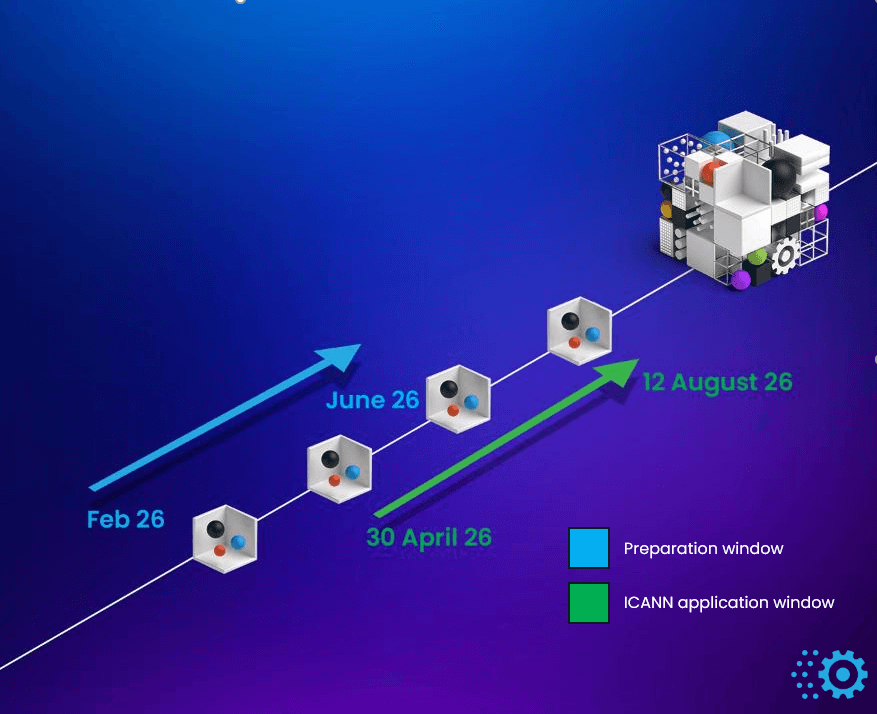
.yourBrand preparation and application windows
The 2026 application window opens on 30 April and closes again on 12 August this year. It could be another decade or more before the next window, so it’s important to carefully consider the benefits that owning .yourBrand at this time will bring your organisation.
We understand that the level of internal approval needed to sign off on this kind of infrastructure decision takes time. That’s why we recommend that your ‘preparation window’ begins now until June 2026 at the latest, to leave you enough time to finalise and submit your application before 12 August.

Let’s find out if owning .yourBrand is the right move
We’ve been working with global superbrands for the past twenty-five years and helped long-term clients, like William Hill, apply for .theirBrand in the 2012 window.
Our experience has taught us there’s a lot to think about to establish if applying for .yourBrand is the right decision for you. So, our expert team has put together a checklist with eight key areas to walk through with your colleagues.
It’s designed to help you keep on track and establish how prepared you are to start your application.
 Download our checklist →
We’re here to help you with .yourBrand
If you need a little more help, you can use our online guide.
If you’d like to delve into each of the eight sections in more detail, our team is on hand to take you through it, step by step.
We’re also here to answer any questions you may have about the application window or your application itself.
Or, if you need a hand to work on your business case – and to start your application in good time before the window closes – simply get in touch below.

Let’s talk about .yourBrand

Marc Roussel
Global Client Services Manager
Let's talk
We can customise a solution to fit your business needs.